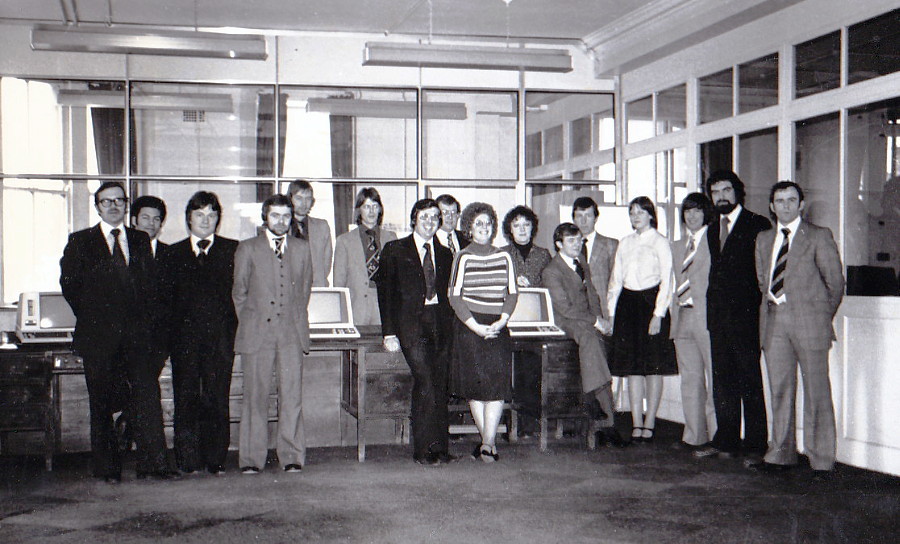
 Photograph taken at Stafford House some time between August 1977 and August 1978
From left to right:
Ron Forecast,
Ambrose,
Steve Hale,
Charlie Potter,
John Atkinson,
Colin Balkham,
Terry Felsted,
Len Bateman,
Barbara Thorogood,
Ruth Tristram/Tooze,
Peter Evans,
Ian Jeffrey (Jeff),
Linda Moulson,
Colin Finnis,
Mike Wilson,
Roddy Morrison
The Project
Key project players
Martin Brampton
Paul Cunningham
John Edelman
Adrian Lee
Mike Rankine
JB Robinson
Frances Rigby
In simple terms, during this period (1970s) when a Lloyd’s broker received instructions from a client they prepared a ‘slip’ setting out the type of insurance and related details. This slip was used to obtain a quote from an
underwriter. If this was acceptable to the client, the broker obtained sufficient lines from brokers to meet the full risk. The broker then submitted the slip and the policy to the Lloyd’s Policy Signing Office (LPSO)
for signing — the allocation of a signing number and date. The LPSO were responsible for debiting the broker and crediting the underwriting syndicates.
System Redesign was a major undertaking to streamline transaction flow between the market and LPSO. The DDE (Direct Data Entry) part of the System Redesign project covered the input of insurance premium and claims
details by LPSO staff, for validation and forwarding to the IBM mainframe systems. The DDE project started life in the Lloyd’s of London Stafford House office in King William Street. The building has since been redeveloped.
Two major software houses were involved in the project, SDL (Systems Designers Ltd) and Leasco. A further business led by Martin Brampton provided a string handling library to augment the Coral 66 programming system.
Even after this redesign, punched cards were in extensive use. In his 1987 article A View of the Room, former CEO of Lloyd’s Ian Hay Davison stated that “
Lloyd’s was
among the earliest users of computers in the UK. The LPSO installed one of the new IBM machines in 1960 and since then the corporation has been a major user of computers. In 1983 there were almost four hundred people
working in the data-processing department — in Chatham and London — both in production and in systems development work. But the present system of central accounting is out of date. It produces its daily
output of advices to underwriting boxes about the risks that have been booked to them in the form of punched cards: 90,000 a day, or 45 boxes of cards. Punched cards are now an obsolete data-processing medium and
the fact that Lloyd’s must now be the world’s largest user of them is not a source of pride”
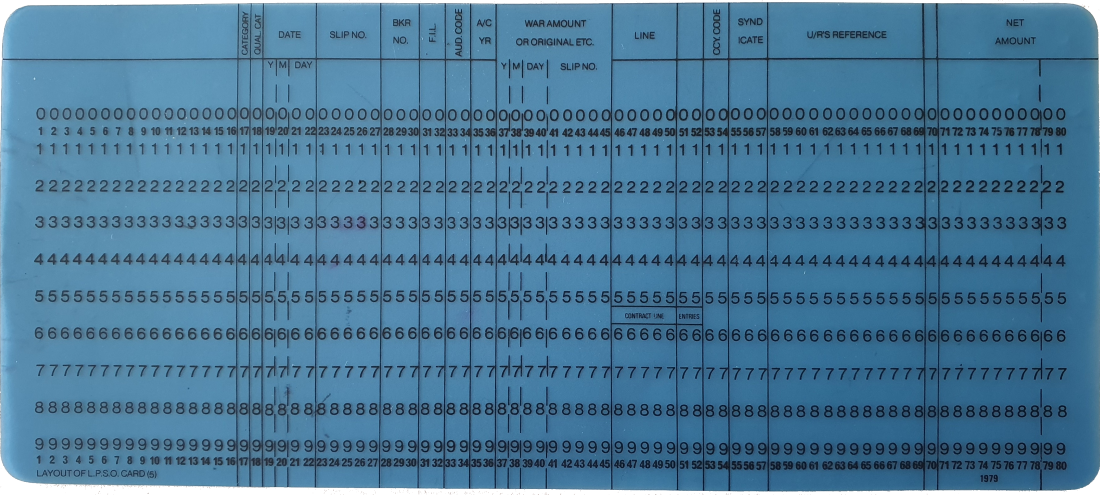 Template for one of the punched cards that were produced daily by the LPSO
Lloyd’s market processing has changed dramatically since the days of System Design. In 2001 Lloyd’s partnered with Xchanging, a company created 2 years earlier by a former partner of Andersen Consulting.
Xchanging entities took over the services formerly offered by both LPSO and LCO (Lloyd’s Claims Office). Xchanging itself was acquired in 2016 by the US software services giant CSC. A year later
CSC merged with the Enterprise Services business of HP Enterprise (formerly Electronic Data Systems) to create DXC Technology. How times change!
Management
Peter Evans
David Menzies
Colin Talbot
Mike Wilson (LPSO)
LPSO liaison
Brian Austin
Simon Church
Brian Foreman
John Fuggle
Roger Gilby
Barbara Thorogood
The LPSO liaison team were responsible for specifying LPSO requirements to the analysts and for user acceptance testing and sign-off. This was not always an easy route to take and we were fortunate that
the team were friendly and co-operative, no doubt inspired by the impressive LPSO executive Mike Wilson.
Analysts
Brendan Balhatchet
Andy Creamer
Martin Doyle
John Farrell
Terry Felsted
Duncan Fosbraey
Steve Hale
Mervyn Leroy
Kate Martin
Kevin Martin
Stuart Mills
Bruce Morrison
Roddy Morrison
Pat Myers
Charlie Potter
Roy Seteram
The analyst team were responsible for documenting business requirements. Different analysts had different approaches, some using flow charts and others pseudo code. They were responsible for testing changes before passing them to LPSO.
At the Chatham site they at one time shared the 'goldfish bowl' office with the programming team.
The task of the analysts was a lot more demanding that the programmers would credit at the time. As well as distilling user requirements they would need to try and simplify user processes, translate their needs into
something achievable, help the users with their tests and invariably carry the can when things went wrong!
Operations
Mike Daniels
John Neal
Russell Thear
Kevin Underdown
The production DDE system ran on a DEC PDP11/70 minicomputer using the RSX11M+ operating system. A separate PDP11/70 was used for development. The PDP11/70 model, launched in 1975, supported a maximum of 4Mb RAM. This is not a lot by modern
standards - the Apple iPhone 13 launched in 2021 has over 1,000 times this in a consumer hand-held device. However it compares well with the Apollo Guidance Computer (AGC) used for the moon landing in 1969, which had a mere 2Kb of RAM and a 32KB hard disk.
The AGC was designed by a team from MIT and built by Raytheon. Raytheon arose from the merger of the UK company Cossor (maker of Melody Maker wireless sets) and the smaller US based Raytheon. Raytheon Cossor were heavily
focused on aerospace and defence but found time later to manufacture the DDE data entry terminals used by LPSO.
The first storage drives used by DDE were RP04 units configured to 88Mb each; this was doubled on the later RP06 drives. These units were the size of a washing machine, and the disk packs
were unsealed and removable. The glass lid at the top slid open and the disk pack could be withdrawn using a clear plastic round cover that was coupled with a case bottom for transport and storage. Exposure of the disk heads
and surfaces to air particles made these disks much less reliable than today’s sealed Winchester style disks. The disk heads retracted but care had to be taken to avoid damaging any of the exposed
recording platters.
Colin Finnis recalls that the RP04 drives had a bad design flaw, in that you could press the button that opened the access door while the disk was run up. This action would promptly shut the disk down. He remembers that on one
occasion a party of VIPs were on a tour of the machine room and one of them lent on a disk drive and popped the door open. Alarms went off and the party were unceremoniously barged out of the way by support staff and
operators trying to get the system back up. When Gun Wharf first opened there were a lot of those visits, but after that incident they were more closely supervised.
 Stock photo of a DEC RP06 drive, with disk transport container resting on top. ©Joe Mabel, CC BY-SA 3.0 via Wikimedia Commons
The data disks were backed up to magnetic tape at the end of the working day, with copies sent off-site. The System disks were backed up less frequently. Backing up to mag tapes was in itself error-prone. After one Preventive
Maintenance stint it was found that previous backup tapes could no longer be read. Apparently the read/write heads had been misaligned and had to be corrected. This meant that the original read-after-write checks had
passed, but once corrected the tape deck could no longer read them. This caused some alarm.
One of the roles of the operator was to boot up the system. Modern computers use some form of read-only memory to store instructions for loading the operating system. The PDP11/70 required the operator to use toggles on the control
panel to specify the boot device (eg magnetic tape, diskette etc) and the load address.
 Stock photo of a typical PDP11/70 Front Panel
Colin Finnis recalls the operators’ rest room, used by operations staff and him occasionally during shift hours. The room had cooking facilities and was well provisioned, and one of the operators whose interests
were more technical than gastronomic once ate a pizza with the polystyrene backing still attached because he didn’t realise that it had to be removed. However the pinnacle of his achievement was to set alight one of his meals, which triggered
the fire alarm. This was connected directly to the fire station, and shortly later the fire brigade arrived tooled up and in full regalia only to discover the operator tucking into what can only described as a burnt offering.
System Programmers
Colin Docketty (Doc)
Colin Finnis
Tony Gillingham
Robbie Hessenberg
John Haddell
Paul Smith
Tony Toms
Ed Tottenham
Lyn Whitaker
The PDP11/70 had to be able to service around 100 data entry clerks, which was a challenge considering its limited capacity. Each program, such as the one processing premiums (aptly named Premium) was
limited to 32Kb memory. The program basically comprised a root module that called overlays as required. The program ran as a single instance, serving one user at a time. When a user process paused, such
as when waiting for a file action or screen refresh, that user’s context would be swapped out to disk leaving the application free for another user. To achieve this, each user was allocated 8Kb of
storage (UDS, User Data Space) for all their data. This data, in addition to the user’s stack (temporary data held in memory) would be swapped out and replaced by data for the next user.
In DDE this procedure was controlled by a Task Manager and File Manager, written in Macro-11 assembly language and collectively known as Middleware. A third component was Comms Manager. This looked after
the physical queuing and transfer of data between Task Manager and the IBM look-alike terminals. The system programmers were responsible for developing and maintaining Middleware and the Operating System
and for supporting the Operators as necessary.
As the early system was designed and developed by 2 separate companies the interaction between applications and system was not as productive as was hoped. A later system rationalised the Task and Comms Managers
into the Application Interface, thereby reducing the system size considerably, and increasing efficiency. This allowed for a much needed extension to its production life.
 That looks like Colin Finnis in the Computer Room, 1978 ©Martin Charles / RIBA Collections
Development programmers
John Atkinson
Colin Balkham
John Bellringer
Andrea Berry
Dave Brinkman
Walter Briscoe
Pat Buckle
Phil Castellino
Mark Compton
Peter Danson
Sue Danson
Fiona Early
Terry Edwards
Wendy Gass
Barrie Hague
Doreen Hague
Mik Horn
Mark Ingram (Markus)
Deanna Jackson
Ian Jeffrey (Jeff)
Paul King (Nelson)
Martin Levy
Richard Lim
Glenys Lovell / Russell
Deirdre Matthews / Peters
Ferdie McLeod
Alison Mings
Russ Morrison
Linda Moulson
Amita Patel
Mel Pullen
Paul Schofield (Biskit)
Geoff Simmons
Marilyn Stevenson
Ruth Tristram / Tooze
Dudley Turner
Penny Ward
Pete Webb
Pete Wright
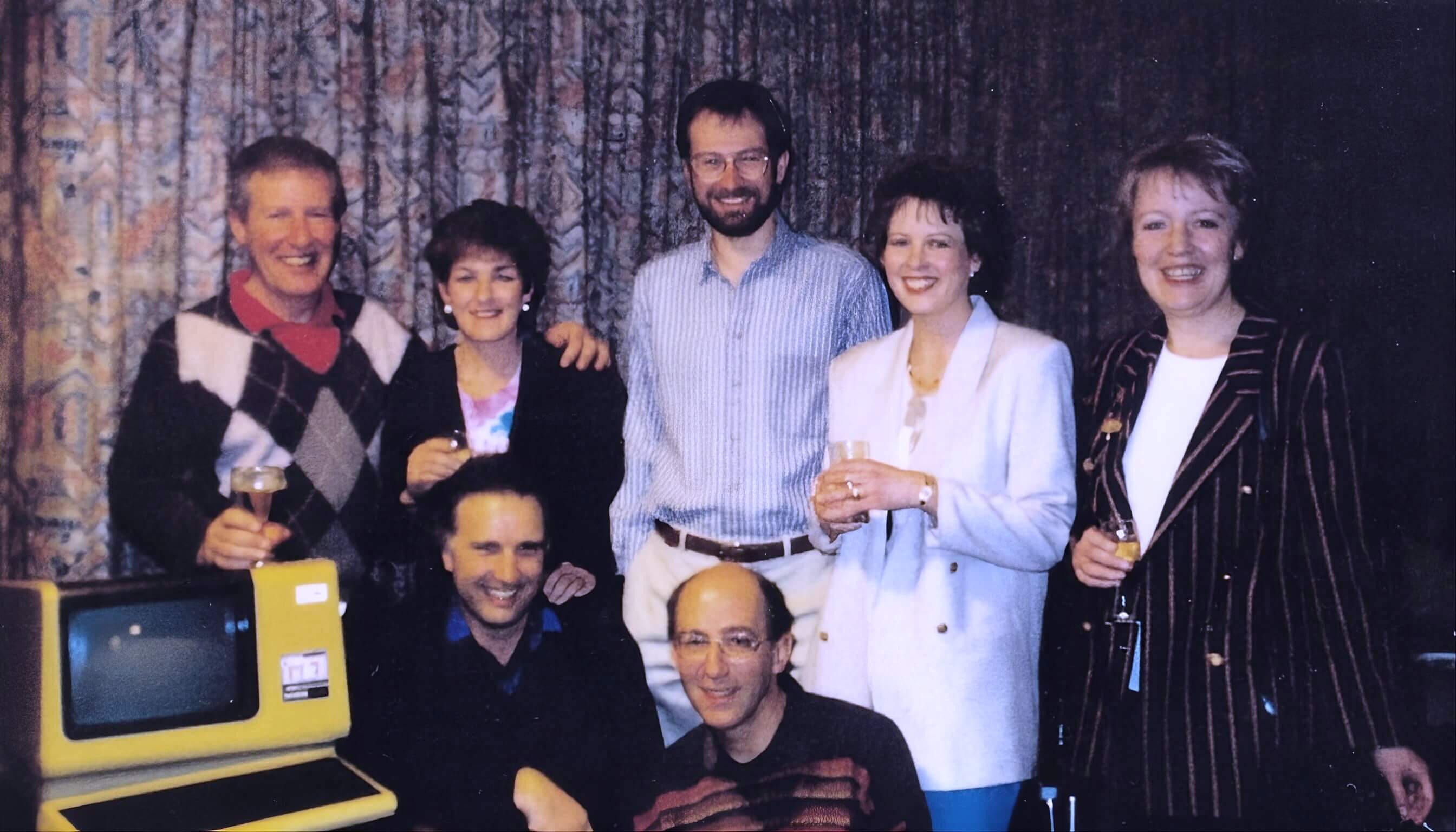 Some of the DDE team in 1996
Top: Ian Jeffrey (Jeff), Wendy Gass, John Atkinson, Linda Atkinson, Ruth Tooze
Bottom: Colin Docketty, Colin Talbot.
The DDE programming line-up varied considerably, as contract programmers came and went. At its height there were two development sections headed by John Atkinson and Colin Balkham and a further support team
responsible for changes and enhancements. Coral 66 code was typed into monochrome screens with a command prompt - no graphical interfaces in those days. The key commands we used at the time were EDT for the editor,
COR/CRL for the Coral compiler and TKB for the taskbuilder (link edit). For general filing activities the Peripheral Interchange Program (PIP) was used. All output was printed on continuous computer paper
from a large and noisy line printer in the computer room.
Coral (Computer On-line Real-time Applications Language) was developed in 1964 at the Royal Radar Establishment and later enhanced (presumably in 1966). It is a fairly feature-light language but with the benefit of
allowing data to be structured and packed into limited storage (down to bit level) like Pascal does. Although targeted at real time applications this was not based on having any in-built real-time statements but rather
by providing features that could produce efficient code. It was used widely for British military programming, such as at Marconi Elliott Avionics up the road in Rochester where some of us learnt our trade.
The main applications validated data input for Premiums, AP/RP (Additional Premium/Returned Premium), Marine & non-Marine claims (excluding motor) and syndicate re-insurance. Each program
had a separate module corresponding to each data entry screen. The Raytheon Cossor PTS VDUs (Visual Display Units) used for data entry were monochrome, capable of displaying 24 rows and 80 columns. The bottom
line of each screen was reserved for messages, primarily to flag input errors. For each application a series of screen maps would need to be created, comprising fixed text and tabbable input fields.
 An example of Coral 66, part of a screen map generating program
Distractions
There were many distractions at the London offices and later at Gun Wharf.
London distractions included The Grapes, the Red Lion, the Lamb Tavern, the Square Rigger and the Princess Elizabeth. The Lamb had the benefit of being large and local, and it featured a sawdust covered floor.
The Square Rigger in Arthur St featured a replica 18th century ship with a large sail and a mast running through the middle of the pub. The pub has since been demolished. Finally, the Princess Elizabeth was a 1927
paddle steamer moored along from London Bridge. Apparently it was active at Dunkirk and has now returned there as a bar/restaurant.
Lloyd’s themselves hosted the Angerstein Bar, a favourite for leaving parties where the vintage Warre's and Taylor's port were much appreciated. John Julius Angerstein (1732-1823) was a very successful
underwriter and broker and was a driving force behind the modernisation of Lloyd’s. Apparently he was instrumental in making Lloyd’s a respected,
well-regulated institution, so one wonders what he would have made of some of our more extended stays at his namesake bar.
Apart from liquid lunches, Colin Finnis reminds us that one quaint tradition at the London offices was the 32½ hour working week, which allowed a 15 minute tea break in the morning and afternoon. A lady used to
actually come round with a tea trolley.
Before relocating fully to Chatham the DDE team worked night shifts during the phased transfer of computer equipment. Two establishments that come to mind during this period were “Sweaty Betty’s” in
Rochester and Farthing Corner services on the M2.
In Chatham, the nearest bar was the one inside the Gun Wharf building itself. It also allowed smoking, for those inclined. Needless to say the bar did not last too long, to the benefit of the newly restored
Command House next door and the KGV (King George V) up the road. For longer diversions you could visit Gillingham and enjoy the Lloyd’s Sports and Social Club, play bat and trap at the Waggon at Hale or go ice
skating at the rink near the Bowater roundabout.
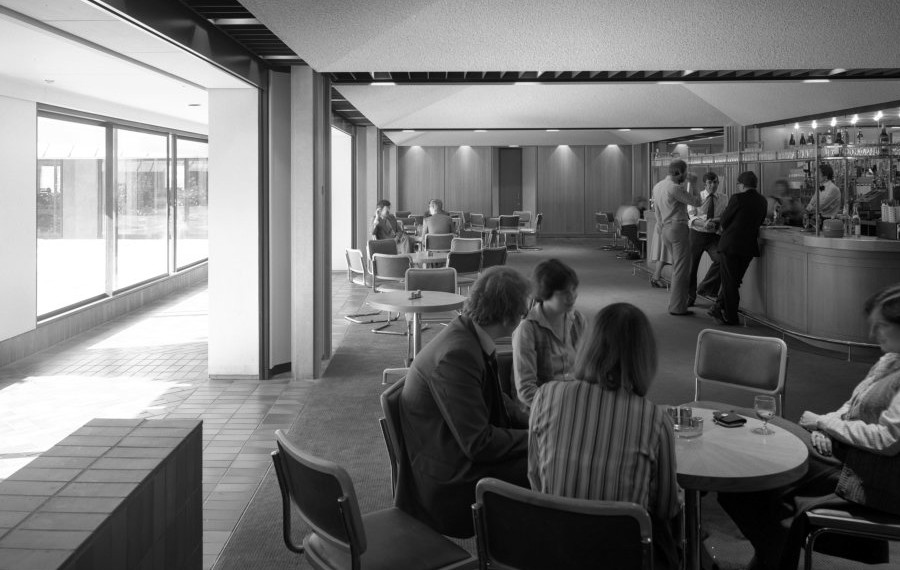 The bar area at Gun Wharf - that looks like Terry Felsted at the bar. ©Martin Charles / RIBA Collections
 A familiar sight, taken in 1978. ©Ben Levick via Flickr
For a completely different distraction there was an opportunity to play Adventure on the PDP. Also known as Colossal Cave Adventure and ADVENT it was a text adventure game developed in the 1970s for the PDP10. This
was potentially a very time-consuming activity, although Doc kindly mapped the cave system out over reams of printout paper.
Colin Finnis remembers installing the Adventure game. The Fortran source code was probably acquired from DECUS, the Digital Equipment Computer Users’ Society. The origin of the compiler is more murky. John
Haddell and Colin later began to add some extra rooms to explore in the game.

To achieve a maximum score it was found that you had to finish without using the spare set of batteries in order to gain a bonus point!
 Adventure on a DEC VT100 like ours ©www.wikiwand.com
Lloyd's took its social rôle quite seriously, and there were many entertainments laid on for staff. Christmas parties were held at local venues such as the Great Danes Hotel outside Maidstone and the Royal Star Hotel
in the middle of the town, now demoted to a shopping arcade. Christmas entertainment included well-known speakers, such as Bill Beaumont and Bob 'the cat' Bevan, who totally eclipsed the supporting comedy act. Another
support act was a hypnotist, who wrung some very out of character behaviour from susceptible staff members.
For the rest of the year entertainment included such varied events as discos, race nights, film nights (thanks to Colin Finnis) and ice skating trips to the rink at Streatham. Many happy memories.
Downloads
Article on Lloyd’s Database ©Accountancy Age (PDF 0.8MB)
Gun Wharf Employee Guide (PDF 6.9MB)
Lloyd’s Administrative Headquarters at Chatham (PDF 9.3MB)
Feedback
With thanks to Glenys Lovell, Colin Docketty, Colin Finnis and Mark Ingram for their recollections and corrections.
This page remains under review. If you have any memories, amendments or photos, please feel free to
email them!
Cookie Policy
Don’t want them, don’t use them.